If you’ve ever watched a forklift operator wrap a pallet of goods in seconds with a roll of machine stretch film, you might’ve thought, “What’s the deal with that stretch?” As a supplier of machine stretch film for over a decade, I get this question a lot from warehouse managers, packaging engineers, and even small-business owners just starting to outsource their packaging. It’s not just a random “stretchy” material—its elasticity is the backbone of why machine stretch film works so well for unitizing loads, protecting cargo, and cutting down on waste. Let’s break this down the way I explain it to my own customers, no stuffy jargon, just real-world context and science that actually matters. Machine Stretch Film
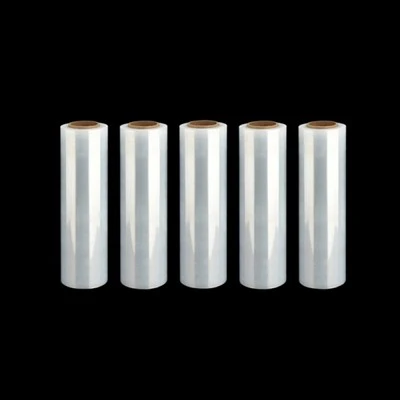
First, let’s define elasticity in plain terms for machine stretch film, not the fancy physics textbook version. Elasticity here is how much the film can stretch from its original length, and then snap back to its original shape once the stretching force is released. This isn’t like a rubber band that you can stretch twice its length and have it snap back—machine stretch film is a polyethylene-based material, mostly linear low-density polyethylene (LLDPE), which is specifically manufactured for consistent stretch. The elasticity of our film, for example, isn’t a single number; it’s broken into two parts: immediate elasticity (how much it bounces back right after stretching) and set elasticity (how it holds its shape over hours or days once the load is wrapped). Most people focus on the stretch percentage, but elasticity is what makes that stretch useful, not just a gimmick.
A lot of customers come to me thinking higher stretch percentage equals better elasticity, and it’s not that simple. Let’s say one roll of film stretches to 300% of its original length, and another stretches to 500% at the same tension. If the 500% stretch film has poor elasticity, it’ll snap right after you wrap a pallet, leaving gaps, and your load will shift during transit. But if the 300% film has strong elasticity, it will stretch just enough to conform to the load, grip tightly, and not relax so much that the load comes undone. That’s why, as a supplier, we design our film’s elasticity to match the needs of the application. For light, irregular loads, we might spec a film with 250-300% elasticity at break, and for heavy, uniform pallets like canned goods or lumber, we adjust it to 350-400% to get that tight, stable wrap.
Why does elasticity matter more than just stretch percentage? Let’s walk through a real scenario. A customer of ours in the construction industry was using a generic machine stretch film from a big box supplier, and their loads of siding would arrive at job sites with 20-30% of the wraps loose. They blamed the “low quality” film, but when we tested it, the film had a 500% stretch rating but only 12% elasticity at break. That means it stretched to 5x its original length, but when they released the tension from the wrap, only 12% of that stretch was permanent, and 88% snapped back immediately—so the film would slip and loosen. We switched them to our industry-grade machine stretch film, which has 280% stretch at break and 45% elasticity at break. The difference was night and day: their wrap tension stayed consistent for 72 hours, even when the job site was hot, and they saw zero load shift complaints in three months. That’s the value of getting elasticity right, not just chasing higher stretch numbers.
Now, let’s get into the science of how we control elasticity in our machine stretch film, because that’s a question our engineering-focused customers always ask. LLDPE resin is the base, but we blend in other polymers and adjust the manufacturing process to tweak elasticity. When we blow or cast the film, we control the cooling rate—slower cooling makes the molecules align in a way that lets them stretch more evenly without breaking, boosting elasticity. We also add slip agents and anti-block additives, but those don’t affect elasticity directly; they help the film unwind smoothly on a machine wrapper so you don’t get wrinkles that weaken the grip. Another key point: elasticity in machine stretch film is not linear. That means the first 50% of stretch is easy, the next 150% is a bit harder, and once you hit that optimal stretch range, the film reaches its peak elasticity before breaking. If you stretch it past that point, it becomes permanently deformed, and its elasticity drops off a cliff—so you never want to run a wrapper at maximum stretch, no matter how strong the film is.
Environmental factors also play a huge role in elasticity, and this is where a lot of first-time machine stretch film users go wrong. Cold temperatures, for example, make polyethylene stiffer, so elasticity drops. If you’re wrapping loads in a freezer warehouse or a job site in winter, a film that works fine in 70 degrees might have 15-20% lower elasticity at 32 degrees. That’s why our team recommends a cold-weather grade machine stretch film for customers operating in temperatures below 40 degrees—we adjust the resin blend to maintain elasticity in frigid conditions. Heat works the opposite: in 90-degree weather, film is softer, so elasticity can be too high, leading to over-stretching and loose wraps. Our sun-resistant grade adds UV stabilizers that prevent the film from losing elasticity when exposed to direct sunlight during long trucking routes.
I often get asked if there’s a way to test elasticity on your own, without sending samples to a lab, which is a fair question when you’re choosing a supplier. A quick field test can give you a good idea, though it’s not as precise as a professional test. Grab a foot of film from a roll, mark the start and end, pull it until it’s taut around a pallet or a heavy object, then measure the stretched length. Release it and measure how much it goes back to original. If it returns to 80% or more of its original length, that’s strong elasticity—our standard industrial film hits around 45% here, so keep that in mind. Another test: wrap a small pallet with two different films, then leave it in your warehouse for a week. Unwrap it and see which film retained tension better— that’s elasticity in action. The old film will be wrinkled and loose, the new one will be tight and conforming, even around edges or corners.
Now, let’s talk about why elasticity isn’t one-size-fits-all. A food and beverage customer wrapping cases of water has very different needs than a metal stamping plant wrapping heavy steel coils. For the food industry, we use a machine stretch film with moderate elasticity—around 35% elasticity at break—because we don’t want the film to stretch so much that it breaks when the wrapper is cycling fast, but we need enough stretch to keep the cases secure without putting too much tension on the load (which is important for food safety, since excessive tension can cause product damage). For metal coils, elasticity is higher—around 50%—because the load is heavy, and you need the film to hold tight even if the coil shifts a little during transit. If the elasticity is too low, the film will snap, and the coil can roll off the truck, which is a safety hazard.
As a machine stretch film supplier, my job isn’t just to sell you a roll of film—it’s to help you pick the right elasticity for your specific application. I’ve had customers who ordered the cheapest film because they thought higher stretch was better, only to end up with damaged goods and higher shipping costs because loads were unstable. On the flip side, I’ve had customers who overspent on a premium film with high elasticity when their small, light loads only needed a moderate grade, wasting money on features they didn’t use. The sweet spot is matching the elasticity to your load’s weight, shape, transit conditions, and wrapper speed.
Let’s wrap this up (pun intended) with the key takeaways about machine stretch film elasticity. It’s not just how much you can stretch the film—it’s how well it holds that stretch without relaxing, and how it bounces back just enough to stay tight. Higher stretch percentages don’t always equal better elasticity; the right elasticity keeps loads secure, reduces waste, and cuts down on downtime from loose wraps or broken film. Environmental factors like temperature and sunlight drastically affect elasticity, so you need a film tailored to where you’re using it. And as a supplier, I’m here to help you test and choose the right film for your needs, not just push a generic product.

If you’re tired of dealing with loads that shift during transit, film that breaks mid-wrap, or waste from over-stretching your machine stretch film, let’s chat. We can send you sample rolls, walk through your specific packaging process, and find the film with the perfect elasticity to fit your operation.
PP Woven Bag References:
- Soroka, W. (2019). Fundamentals of Packaging Technology. Institute of Packaging Professionals.
- Hirsch, E. (2021). Polyethylene Films for Industrial Packaging. Journal of Packaging Science and Technology.
- United Parcel Service (2020). Packaging Material Best Practices for Heavy Load Transit. Supply Chain Solutions Report.
- American Society for Testing and Materials (ASTM) D882-18, Standard Test Method for Tensile Properties of Thin Plastic Sheeting.
Linyi Dongyi Import&Export Co., Ltd.
As one of the most professional machine stretch film manufacturers and suppliers in China, we offer a wide range of products with superior quality. We warmly welcome you to wholesale bulk customized machine stretch film from our factory. If you have any enquiry about quotation, please feel free to email us.
Address: 4 F, Zone A, Zhangjia Zhuxu Village, Lanshan District, Linyi City.
E-mail: donglai01972@gmail.com
WebSite: https://www.donglaipack.com/
